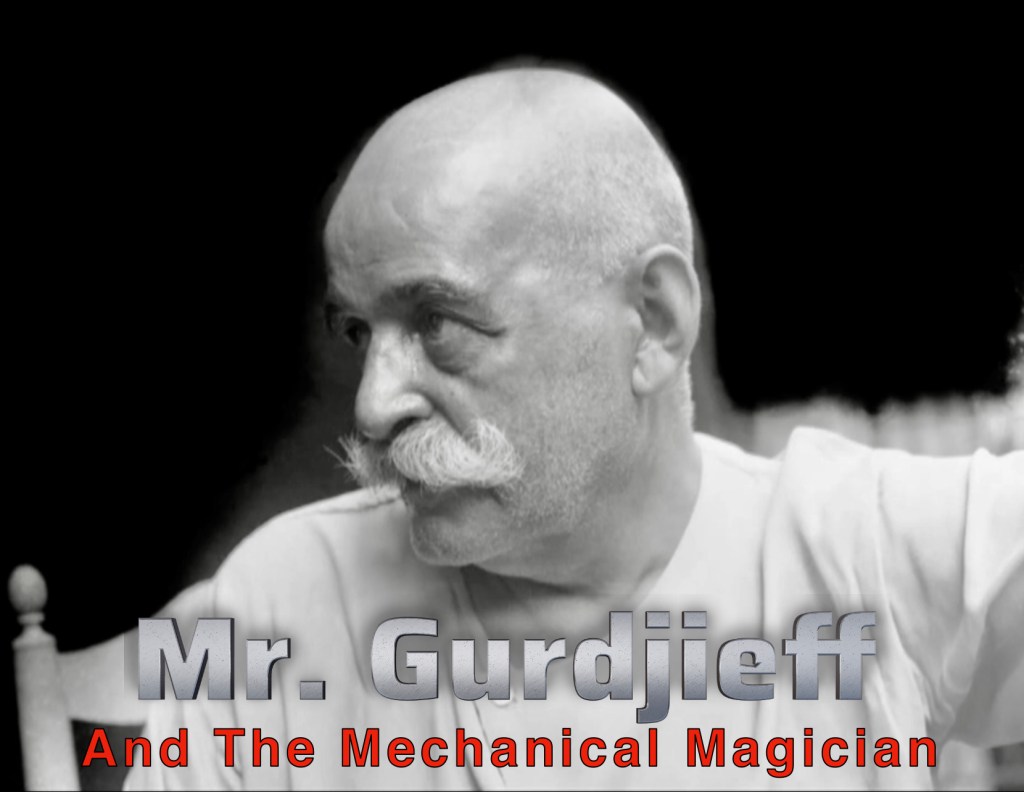
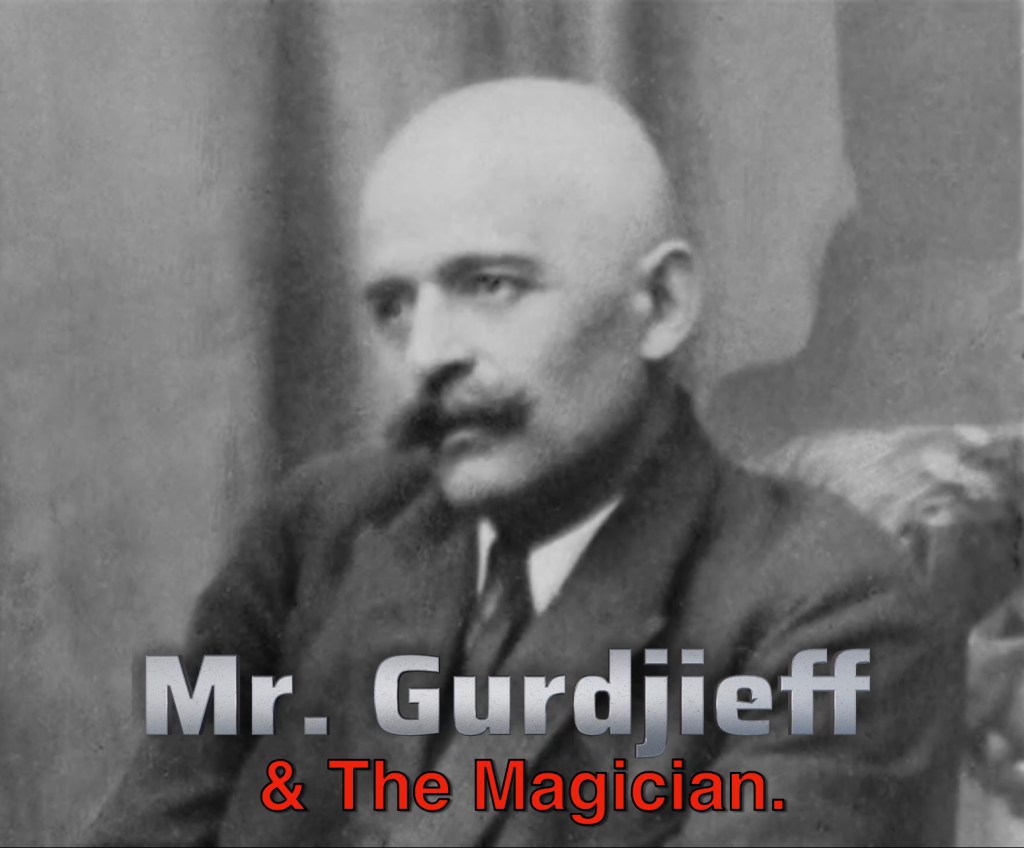
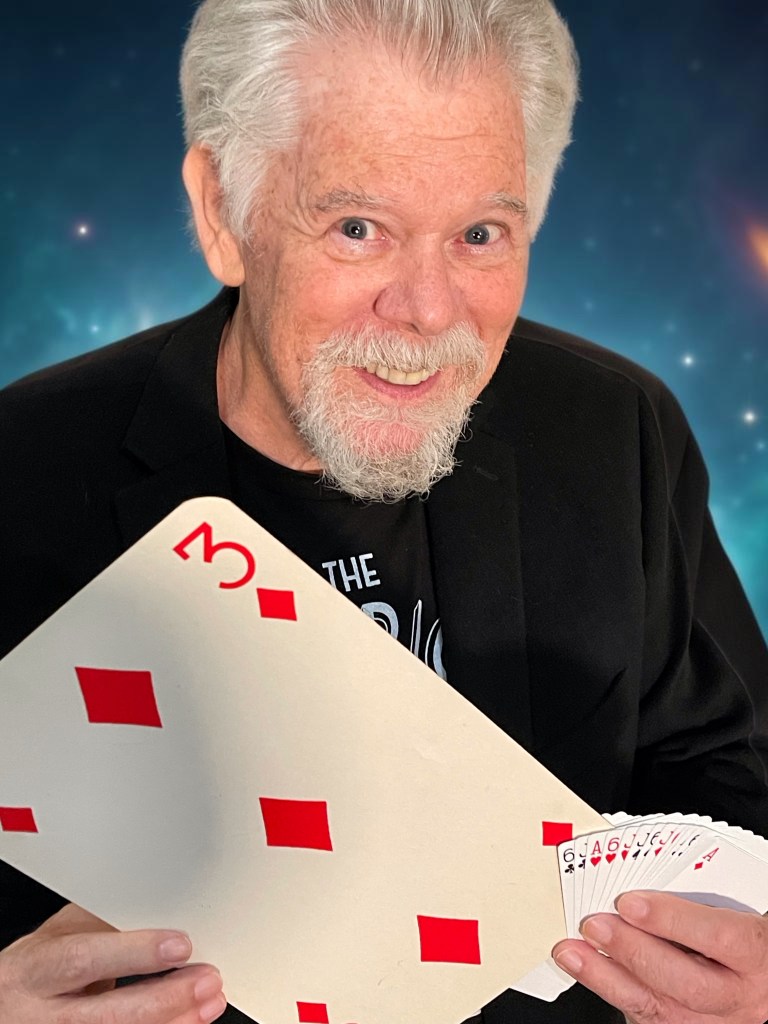
Mr. Gurdjieff & The Magician as Machine.

•June 4, 2025 • 1 Comment

To awaken is not to escape the machine – it is to know it, master it, and use it consciously.”

Mr. Gurdjieff’s sobering observation was this: humans are machines. We operate out of habit, conditioning, and impulse. Our thoughts are borrowed, our emotions reactive, our actions unconscious. Without awakening, we have no true will.

Now think of the magician. A card trick performed a hundred times can become automatic. The charm becomes rehearsed. The performer smiles not because he feels joy but because he knows the script says to.

The Fourth Way challenges the magician to disrupt this mechanical cycle. Through self-observation—watching oneself impartially—the magician begins to see where he’s asleep onstage. He notices when his gestures lack life, when his engagement drops, when ego sneaks in.

This is not cause for despair but for Work. Every moment of mechanical behavior is an opportunity for self-remembering—to wake up in the act, not just go through the motions.

Mr Gurdjieff & the Magician. Introduction.

•June 2, 2025 • Leave a Comment

I have followed the ideas of Mr. Gurdjieff for 45 years now. He was a very special person. I have attempted to mix my study of the Fourth Way with my lifelong love of magic. It has been a very challenging G.I. Gurdjieff was born around 1866 (the exact year is debated) in Alexandropol, in the Russian Empire, to a Greek father and Armenian mother—an upbringing rich in cultural and spiritual traditions. His father, a bard and storyteller, exposed him early to epic tales and oral wisdom, which sparked his lifelong fascination with ancient knowledge. Raised in a region at the crossroads of East and West, Gurdjieff was immersed in Christian, Muslim, and esoteric influences from an early age.

As a young man, Gurdjieff pursued a restless quest for truth, traveling through Central Asia, the Middle East, and North Africa, seeking hidden spiritual schools and ancient teachings. These journeys formed the mysterious backbone of his later teachings, which blended Eastern mysticism with Western psychology in a system he called “The Fourth Way.” Rather than withdrawing from the world, Gurdjieff insisted that real inner development must occur within the chaos of everyday life.

He arrived in Moscow around 1912 and began attracting a circle of devoted followers. His charismatic, enigmatic persona and radical ideas shook up conventional spiritual and philosophical circles. Later, fleeing the Russian Revolution, he established the Institute for the Harmonious Development of Man in France, where he continued to teach, write, and develop his system until his death in 1949. Gurdjieff’s influence remains potent today, his legacy passed down through students like P.D. Ouspensky and generations of seekers searching for the ever-elusive “real I.”

The teachings of George Ivanovich Gurdjieff offer a radically different approach to personal development—one that speaks directly to the soul of a performer. Unlike the traditional spiritual paths of the fakir (physical endurance), the monk (devotion), or the yogi (intellect), Gurdjieff’s Fourth Way demands engagement with all aspects of the self simultaneously, and in the middle of ordinary life.

For the magician, this idea isn’t foreign. He must master his body’s mechanics (the sleights), his emotions (performance energy), and his intellect (understanding of timing, structure, and psychology). The stage is his crucible; it is where self-work happens, not apart from the world, but within its spotlight.

The magician who takes up the Fourth Way begins to perform not just for applause but for evolution. The act becomes a meditation, and the audience, unwittingly, becomes part of his spiritual experiment.

Hughes, Zabrecky, Diffatte.  As Good as Comedy Magic Gets.

•June 1, 2025 • Leave a Comment

Austin, Texas, is the world’s live music capital and home to the South by Southwest and Austin City Limits Festivals. It has a vibrant and incredible musical scene. Now and then, however, you must spend an evening without hearing a mandolin and bluesy guitar riffs! Sometimes you merely want to enjoy a good laugh; this is where the Moontower Festival comes in!

Every April, the Moontower Comedy Festival takes over the city, and for two weeks, over 150 comedians take over every venue in town. An international roster of star comedians, headliners, and the cream of the crop of contemporary comedy performers converge on ATX (as we locals refer to it), and comedy runs wild. I hope that sets the stage before I tell you about one of the finest evenings of Comedy Magic that I have seen.

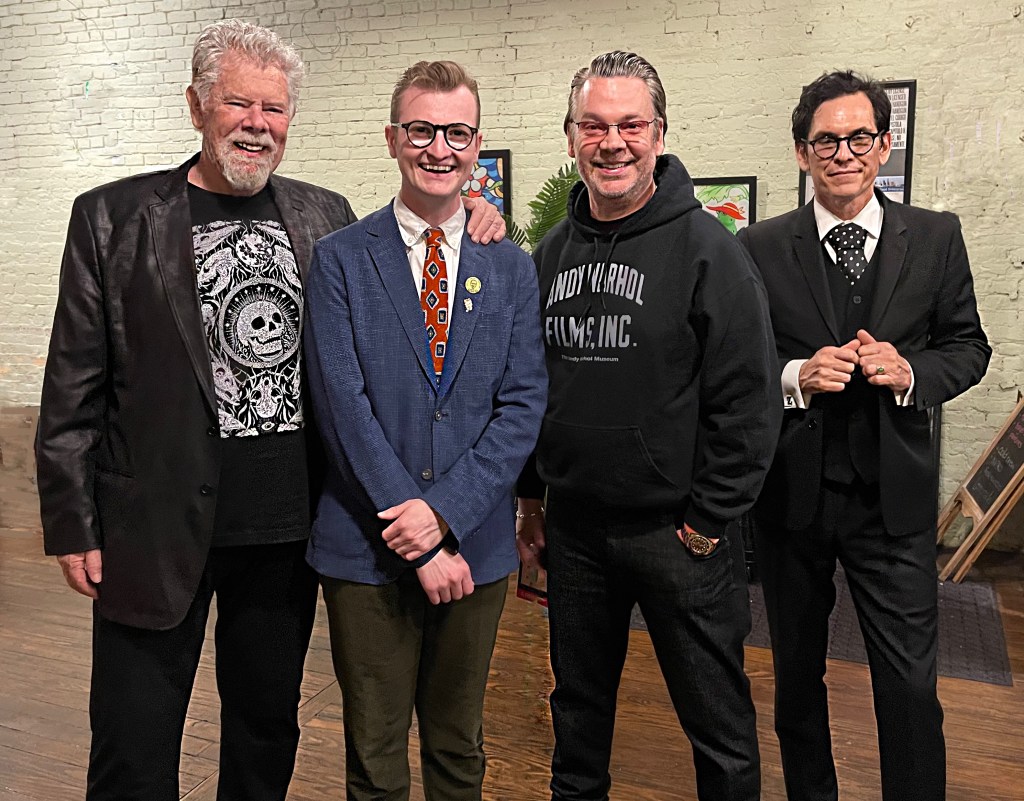
When we discovered that Derek Hughes, Rob Zabrecky, and Nick Diffatte were performing, we immediately bought tickets and marked the date in red on our schedule. I was particularly excited because while I had met all three performers, I had never seen them perform live. The fact that all three were performing together was particularly thrilling. How often do you see three seasoned headliners of this caliber sharing a stage? Not often.

Hughes, Zabrecky, and Diffatte performed eight shows in Austin; seven were at the Hideout Theatre, a small black box theater in the heart of town, and one at the Cap City Comedy Club. Susan and I caught their first show at the Hideout, a sold-out/standing ovation event. There was a smattering of local magicians in attendance, and as the evening progressed, I was checking out their faces and quickly realized that it wasn’t just me who thought this was something special.

Hughes opened the show with a simple but highly visual card trick that showed how effective a piece of pure sleight of hand can be onstage. He also seamlessly set up moments that would come together later in the show. Derek divided his set into three segments to interweave with the other performers. All his routines were performed casually, but they had kick-ass magical punches. The Invisible Deck is often described as the world’s best card trick. Derek turned it into something special with great handling and an overlapping extra layer to the mystery. 

Derek Hughes hosted the show in a friendly, relaxed manner that made it look easy. Spoiler alert: it isn’t! Every performer who has attempted it will tell you that doing a good job at MCing is anything but easy. Derek set up each act nicely and kept things moving at a perfect tempo. The audience knew they were in the hands of a pro, and that is what’s needed.

The first act that Hughes introduced was Rob Zabrecky, whose charmingly off-base persona was an excellent contrast to Derek’s style. If you haven’t seen Zabrecky perform, his show is an object lesson in creating a stage persona that envelops his entire performance. Slightly spooky and very funny, Zabrecky began his act with a fast visual effect and then a “ghost touches” routine using two spectators and a feather. Next, Rob performed a “picture analysis” routine that closed with a drawing duplication. Zabrecky’s experience as a pro showed in his skillful and respectful handling of his onstage volunteers.

Rob closed with a beautiful version of the Diminishing Cards, which allowed him to make an elegant final exit from the stage. As he headed offstage, he was still casually tossing tiny cards in the air. It was a beautifully realized ending to his set. Zabrecky is an original who has invested himself in every aspect of his work.

Hughes used his calculator to predict a date and exact time to close out the show. I’ve never been a fan of iPhone calculator tricks, but this was different because the entire audience was invited to follow along with the process on their phones. Derek did a superb job on all fronts!

For the final act, Derek introduced Nick Diffatte. Nick has established himself as one of the brightest young stars in the magic world. He performs unusual and original material, and he had the audience in the palm of his hand within seconds. Nick’s act is filled with potent magic, verbal and visual comedy, and callbacks. Diffatte has structured his show expertly, but is far too smart to let an audience know it.

Nick’s show highlighted his signature “spoons in glasses” routine and a funny gag/trick involving a ball prediction. He also performed a “spectator’s ring to magician’s toe” effect that involved great visuals while a spectator onstage removed his shoe and then cut away the end of his sock to reveal the missing ring. This routine is a modern classic of comedy magic.

Diffatte closed his segment with a curiously deranged version of the 20th Century Silks while standing on a chair. It was funny stuff and a strong closer that left the audience on their feet, applauding. Nick is a fine performer who combines great sight gags and impressive feats of magic. The entire cast took a final bow together, which resulted in a full standing ovation and loud cheers from the audience. The energy and excitement in the room were palpable, and it was clear that the audience had experienced something truly special.

The laughs came thick and fast throughout the show, and I am no fan of taking notes (I think it is better to be a committed audience member), so I apologize if I confused the sequences of carefully layered magic. When you laugh as hard as I did, it is tough to make mental notes. So much was packed into that 75-minute show that it wasn’t easy to catch all the subtleties. I tried, but was quickly caught up in the action and laughs. 

The casual rapport shared by these three performers, coupled with their very different styles and personas, made this one of the most textured and enjoyable comedy magic shows I have seen. My only criticism is that it was too short! I suspect that this show will be touring extensively in the near future. Don’t miss it!

Etiquette of Performing a Show in Someone’s Home.

•April 28, 2025 • Leave a Comment

Performing a magic show in someone’s home is a unique experience that combines entertainment with intimacy. Unlike stage shows, home performances bring the magician directly into a guest’s personal space. That closeness makes etiquette even more important. A magician who respects boundaries, reads the room, and remains professional will leave a lasting, positive impression. One who doesn’t risks awkward moments, damaged property, or even social fallout. Here’s how to do it right.

1. Communicate Clearly Before the Event

Everything starts with clear communication. Once someone invites you to perform at their home, have a conversation that covers the basics:

  • Time: Confirm the start time, expected duration, and when you should arrive to set up.
  • Audience: Ask about the audience size, age range, and any sensitivities (e.g., cultural, religious, or personal topics to avoid).
  • Space: Find out where you’ll perform — living room, backyard, basement? Ask about space, furniture arrangement, and access to power outlets if needed.
  • Expectations: Are they expecting a close-up magic set, a stand-up routine, or a full mini-show? Will people be eating during your act? Will there be other entertainment?

This conversation ensures you bring the right equipment and tailor your performance to the crowd. It also shows respect for the host’s plans and sets a professional tone.

2. Arrive On Time — But Not Too Early

Punctuality matters, but showing up way too early can stress the host out. Aim to arrive 20–30 minutes before the show starts. That gives you time to greet the host, set up quietly, and get a feel for the environment. If something delays you, notify the host as soon as possible. Being late to a private event isn’t just inconvenient — it’s disrespectful.

Dress appropriately, too. The magician’s look should match the tone of the party. At a kid’s birthday, fun and colorful is fine. For a formal dinner party, go for neat and neutral. Never look sloppy or like you just rolled out of bed.

3. Respect the Home Like It’s Sacred

You’re a guest in someone’s private space. Treat it that way. Take off your shoes if everyone else is doing it. Don’t snoop, wander into rooms uninvited, or touch things that aren’t part of your setup.

Be mindful of furniture and surfaces. Don’t set props on their heirloom dining table without a cloth underneath. Don’t block walkways or doorways with your gear. If something gets knocked over or damaged,own up to it immediately and offer to make it right.

If you’re bringing assistants or helpers, make sure they follow the same standards. One person with bad manners reflects poorly on the whole team.

4. Read the Room

When the show starts, your job isn’t just to perform tricks — it’s to connect. Read the crowd. Watch their faces. Adjust your pacing and tone accordingly.

In a living room, people are often closer than in other settings. That intimacy means reactions are more visible — so is discomfort. Don’t pick on shy guests or single people out for jokes unless you’re 100% sure they’re into it. What feels like playful banter to you might embarrass someone else.

Keep the humor clean unless the host explicitly requests otherwise. Even if the adults seem open-minded, you don’t want to make off-color jokes that make someone uncomfortable — especially in their own home.

Audience participation is great, but not everyone wants to be part of the act. Ask for volunteers — don’t draft people. And when someone agrees to help, thank them, guide them clearly, and never make them feel foolish.

If kids are part of the show, take extra care to make them feel safe and successful. Magic is about wonder, not humiliation. Praising a child for doing something “magical” — even if you’re secretly doing the trick — creates a memory that sticks.

6. Don’t Overstay Your Welcome

Stick to the agreed runtime. People may be planning food, speeches, or other activities. Going long can throw everything off. Once your show ends, thank the host and make your exit smooth. Don’t linger unless you’re invited to stay.

If guests swarm you for impromptu tricks afterward, it’s fine to do a few more — but gauge the host’s vibe. If they’re cleaning up or trying to move on, wrap it up.

7. Leave the Place as You Found It

5. Include the Audience — Without Putting Them on the Spot

After your performance, pack up neatly and quickly. Check for stray cards, coins, props, or trash. Don’t leave any mess behind — even confetti or balloon scraps from a kids’ show should be cleaned up. The last thing a host wants is to find a card under the couch (or on the ceiling!) two weeks later.

If you used furniture or moved items to set up your show, put everything back where it was. And if the host offers you food or drink, accept politely or decline respectfully — don’t assume you’re entitled to anything just because you performed.

8. Follow Up.

A quick thank-you message the next day — via text or email — goes a long way. It shows appreciation and keeps the door open for future gigs or referrals. If they enjoyed the show, they might tell their friends, and that follow-up adds a layer of professionalism. 

Afterthoughts

Home shows can be some of the most rewarding performances for a magician. They strip away the distance of the stage and let you create real, up-close experiences. But that same intimacy makes etiquette crucial.

You’re not just entertaining — you’re stepping into someone’s personal space. The right tone, behavior, and awareness can turn a good magic show into an unforgettable one — not just because of the tricks, but because the magician brought more than sleight of hand. They brought respect, presence, and professionalism.

That’s what people remember.

Avoiding Pitfalls: Don’t Get Trapped by Your Act

•March 9, 2025 • Leave a Comment

I want to discuss a topic that affects every magician.  It is a certain slippery, nebulous, ever-changing concept called “The Act.” I want to give you a quick rundown on why you need an act, how to put the act together, and a topic seldom discussed: how to avoid being trapped by the act. Hmmm, “Trapped by the Act” sounds like a Graham Green novel from the ’50s!

When I first became a magician, I had no idea what an “act” was or how to formulate one. For me, a show was all about the tricks and my exciting new props, and for many magicians it still is. I remember when I joined my first magic club, The Sussex Magic Circle, at the age of 13. I worked from a large table onto which was placed nearly every prop I owned. I wanted to select the tricks in my show “on the fly,” I told myself. Looking back, I realize I just wanted the members of the magic club to swoon over all my exciting boxes, gizmos, and gadgets! One thing that I didn’t have was an act.

During the following years, until I moved to the United States in 1974, I performed every different kind of gig I could book. Kids Shows, Cabaret, Talent Contests, Nightclubs, Cruise Ships, and Corporate Events. You name it – I did it. This gave me a wonderful feel for the material I was working on. It helped me find the strengths and weaknesses of each piece when performing for very different audiences. This allowed me to build an ever-changing list of Openers and Closers. Thse are the first vital blocks used in creating an act. There are many ideas about what works best in these two slots. The simple answer is whatever works best for you but learn the rules of stagecraft before you replace them.

Upon arriving in California in January ’74, it did not take me long to start performing at the Magic Castle in Hollywood, and this was where I began creating the true nucleus of my “act” by performing 28 shows in a week. Then I started to add Middles to my list of Openers and Closers. My dear friend and mentor, Billy McComb, encouraged me to write my routines down on index cards. At the top of each card was the name of the trick, underneath it the kind of trick (i.e. Opener, Closer, Middle, etc.), the approximate running time, the type of trick (i.e. Cards, Mentalism, Silks, etc.) plus every other pertinent detail. Do you need an assistant onstage? What table do you need, if any?  On the back of the index card, list every prop you need to perform the effect (deck of cards, black Sharpie pen, silk handkerchief, etc.) All these index cards are then wrapped with a couple of rubber bands, ready to be spread, rearranged, and studied like a deck of ancient tarot cards.

I went into quite a lot of detail about the “Index Card” act building system, and yes, I am aware that every younger magician will say, “I can do that on my computer.” Yes, of course, you can, and if you so desire, I highly recommend the “Drafts 4” App because of the ease with which elements can be adjusted and amended. However, there is something wonderfully physical and delightfully tactile about shuffling those index cards around. I swear it will make you more creative!

By now my show had some strong sequences that were beginning to slot together nicely. I then worked very hard at connecting the magic by integrating some strong linkage in the form of short magical surprises and hunks of comedy. I put all of these “bits” of linkage onto index cards and added them to my collection. Linkage is a very important issue for any magician.  The difference between a pro and an amateur magician is that you never notice when a pro is moving from one to the next – unless he wants you to. With less stage time, the tendency is to perform a trick, and when you finish it, start another. 

Starting in the 1980’s, I spent 11 years headlining on the comedy club circuit. This was the time that I polished and perfected my show. I learned a great deal from my time spent in the comedy world. Young comics worked hard every day creating new and topical jokes and I picked up tips galore. I learned how to structure a good callback and to use fewer words to tell a joke. I fine-tuned the act until it became a well-oiled machine!

In the mid-’90s, I began a five-year run with my one-man show in Las Vegas. I fervently maintain that the best way to improve your show is to perform it. I had been playing Las Vegas since the late ‘70s, but a long-term show was another thing entirely. Two 65-minute shows a day, six days a week, 48 weeks a year is a lot of shows! By the time I left my Vegas gig, the act was as solid as a rock and smooth as silk. However, it had become so intricately layered, timed, and full of visual and verbal callbacks that the act had become an entity of its own. I was just the curator.

The timing and structure of my act were taking away the spontaneity from my work. I tried some fun ways to explore this new situation; my favorite stunt was reversing the running order of my show. Yes, if you want to acquire some serious insight into your act, give this technique a shot. What did I learn from this “Act Reversal Exercise?”  Having spent decades getting the act exactly where I wanted it, I discovered that playing with the line-up structure of the show left me free to scatter my stand-up comedy into new settings.

It was very liberating when I recently decided to retire my “old” act.  I had made a great living and lots of money with those tricks, gags, and bits that had eventually evolved into my “Act.” However, I am currently working on a new show that uses nothing from the old act. What is life without a challenge? My Bottom Line: A performer must create an act that will work anywhere, anytime, for anyone. Then, they must learn to perform it anywhere, anytime, for anyone. Once you have got your act together, make sure you don’t get trapped by it! 

Five More Essential Tips for Corporate Entertainers.

•December 23, 2024 • Leave a Comment

In my last post, I gave five of my best tips and techniques to avoid them old corporate blues. Corporate events can be the best of gigs and the worst of gigs. However, they will probably be your best paying shows of the year. This time, I will give you five more tips that have worked for me over the years.

1       Make sure that your performance area is as close to the audience as possible. You do not want a vast gap between you and your spectators; this space is often referred to as a “comedy moat” and can kill any show instantly. Arrive at the venue and ensure there is no massive dance floor between the audience and the little stage in the far corner they have designated for you. If this is the case, working on the dance floor is usually far wiser than fighting the long-distance attention war. The longest and most uncomfortable time in human existence is how long it takes a spectator to get up, walk across a cavernous dance floor, and climb up steps onto your stage. Bookers sometimes think they are doing the magician a favor by isolating him on a faraway stage, well, unless you have more and bigger props than Franz Harary learn to graciously just say,“No.”

2       While you will almost inevitably begin your performance way later than the optimistic and unrealistic guesswork featured on your contract, don’t bank on it. At least once a year, you will find yourself facing an on time or even (gasp) an early kick-off to your performance. Be ready early; you can always kick back with a cup of coffee and idle away some time on your iPhone. You only get one shot at a specific corporate event, so don’t run the risk of blowing it over such an elementary mistake. The client usually has no idea of the way an evening will unfold time wise, so be one step ahead and as prepared as a Boy Scout.

The reason for the remainder of the payment to be delivered prior to show time is obvious. Once you have performed that show, your importance to the company has vanished into thin air. You may well find that you are delivered into a “standard” billing cycle, and that might easily be a 90-day cycle. Entertainment should be a cash-on-the-barrel form of payment, it may be OK for the company to put their manufacturers on a 90-day billing cycle, but they are a large company and you are an individual. If your remaining 50% payment check is not waiting in an envelope for you prior to showtime that is the time to extract a definite guarantee that a check will be cut and mailed to you the very next day. You can be nice, but must remain firm, this is how we arranged to do business, and that is why we signed an agreement.

I usually recommend a 45-minute length for my after-dinner show, but I do so with the following caveat, “If the crowd is having a blast, we can stretch it another 10 minutes or so. I seldom do this though, because 45 minutes is a rather long stretch for any audience who not only hasn’t paid to see you, but had no idea that you would even be there. The other scenario I slip into is, “Of course, if the show is running late, we might want to tighten it to 35 minutes.” I then suggest we just write it into the contract as 45 minutes and play it by ear. I have never had anyone say, “No, damn it, I want a full hour!” However, if you signed a contract to perform for a full hour, then you might well find a bead-counting exec who bitches if you did that same 45-minute set. Your job is to guide the buyer with your devastating expertise in these situations, so don’t be afraid to be an expert.

4       The only way that I will address my financial remuneration for a corporate event is a 50% deposit with the return of the letter of agreement (I have eliminated the term contract) to reserve the date, with the remainder payable prior to show time. This way, if the client cancels the gig, you are covered, you can always offer them that 50% as a deposit on a future booking, or you can even return the deposit if you want to. The choice is yours. This is a very reasonable way to do business, and it can quite honestly be described as a standard in entertainment booking. This protects both you and your client because it establishes that you will lock into that date even if a higher paying one comes along.

5       If you have been booked by a corporate buyer, agent, producer party planner, etc., if you book any subsequent gigs because of that booking, then you must run any bookings through them. Make sure you request a pack of their business cards in advance to give to prospective clients. You will get bonus points from your buyer just for doing so! This is the way that things are done, and if you try to squeeze your representative out of a future booking, you are making a big mistake. They always find out about it; they guard each potential future client like a mama bear guards their cubs. You might win a short-term battle if you book the next date yourself, but you will lose the long-term war, and believe me, the only way to go about being a corporate entertainer is to think long-term.

I hope the tips I have given in these two blog posts will be of use to you in your corporate shows. Needless to say, a great deal of what I have said applies to all kinds of magic show.

Them Old Corporate Blues.

•November 8, 2024 • 1 Comment

I have performed many corporate shows in the last five decades. However, I have always had mixed feelings about these corporate gigs. What do I like about them? That’s easy, I love the money. What don’t I like? Practically everything else! I have learned a lot about corporate shows and would like to offer some tips to avoid those old corporate blues.

The first time I remember this kind of work having its own classification was in the late ‘70s when they were referred to as “Industrials,” a term that very quickly lost favor and was replaced by the term Corporate Show. Later, as if to equalize some strange and non-existent stigma, these kinds of gigs were referred to as Private Dates. This never really caught on with entertainers who not unreasonably used this term to refer to bookings for individuals.

If you are booking a corporate show through a representative of the company, and not an outside source, the consequences can be sky-high for that unlucky soul who seals the deal and signs the contract for an independent entertainer to represent their company by entertaining at a corporate function. If the show goes wrong the individual can and will be held directly responsible and they may well be fired. The fact that the executive who booked the entertainment has no real knowledge about what they are doing, didn’t ask to do it, and receives no extra pay for doing so, is neither here nor there. It isn’t fair but that is just the way it is.

This is the reason larger corporations use specialty bookers and producers to hire their talent—plausible deniability for the executives involved. This is the reason why corporate buyers are very careful with the talent they hire. A joke that is too risqué or an unacceptable choice of words during a show, and that buyer could lose a high-budget client in less time than it took to tell the joke or say the word.

What are these pivotal triggers that must never be pulled, mistakes to avoid, and red lines in the sand that must never be crossed by a comedy magician? Well, pretty much what you would expect, but that doesn’t mean that we shouldn’t run through them here. Here is a breakdown of some thoughts that might improve your learning curve.

1       No bad language of any sort. It doesn’t matter what the executive who booked you might have said about the “guys” liking it a little blue. It only takes one person to complain and all hell can break loose post-show. Your language should be purer than the driven snow. Don’t even say, “Damn” because that is short for “God Damn” which can be a problem. Darn or Dang is OK though. You might want to say, “Gosh!” Instead of expressing dismay by exclaiming, “S#@T” you might not want to replace it with, “Shoot” because someone might mishear you. Try something kinda’ retro like, “Oh, Brother” which worked just great for Jack Benny.  Everyone will know what you meant anyhow and will respect your savvy for not saying it.  It is wise to remember that although an executive might be swearing like a trooper at the bar moments before the show began, he might be the first in line to complain to the boss if you use any of the same language. 

2       When telling a joke avoid the instant trouble spots that can best be summed up by, politics, religion, and sex. Other areas can present problems depending on the time and climate, but if in doubt you should learn to live by the old homily, “If in doubt, leave it out…” Boring but safe advice. No corporate booker wants an edgy entertainer unless they are a star who is famous for being edgy, and they probably shouldn’t hire them anyway. I once performed at a corporate event, and the previous year the company had hired the CEO’s favorite comedian Sandra Bernhard. The CEO was convinced the audience would love her, and he couldn’t have been more wrong. Even worse, as she began seriously bombing, she turned aggressively hostile towards the audience. Even as CEO that man was lucky to keep his job. I’m with the audience on this one!

3       Be politically correct, even if you are the only person at the event who is, you can’t say or do anything that looks in the least like it might approach being racist, sexist, or any other of those minefield words that end in ‘ism. I once performed at a training meeting for IBM (the computer people, not the magic clubs) and my contact gave me a very long lecture on the phone about the fact that there were going to be women present as part of the team. “You must not treat them in any way differently to the men,” he said. It was an early morning training session and as I arrived in the office, I heard this same executive saying, “OK, before we begin, why don’t you gals go and make the coffee and bring it in so we can begin the session.” Hmmm, that was a few years ago, maybe he has learned to walk the walk by now as well as talk the talk. Then again, perhaps he has been replaced by a female executive.

4       Be very careful about using volunteers to take part in your show. They must be treated with kid gloves, especially if they are brought up “onstage.” They are being placed on show in front of their business peers, and you must be sure that they are not embarrassed in any way. Put away any notion of performing that Instant Magician routine that killed in the school fundraiser. I used to ask my booking contact for some ideas about which of the spectators to be involved in my show. I stopped doing this because on way too many occasions I discovered that the person I had been steered towards was either the biggest asshole or the biggest drinker in the group. Apparently, they thought these attributes might make them especially useful assets to my performance. 

Usually in after-dinner banquet shows the audience is a blend of the company’s sales team, their clients/buyers from other companies, and a smattering of home office executives. If you need to involve a participant from the audience, it is a lot safer to make it a member of the company’s sales team than anyone else. I also frequently emphasize a team-building theme with my handling of The Linking Finger Rings routine. This allows me to incorporate some suggestions about company involvement without needing to bring any of the participants up on stage. I can adapt patter about linking the sales team with the R & D team, and the executives with the engineers, etc. I have found this to be a very popular approach with my corporate clients. However, like so many other elements, I am a firm believer in not overdoing this approach, as always, less is often more.

5       Always have a very short introduction written up and printed on paper for the executive whose job is to introduce you. For some reason, if you utter the fatal words, “I’ll leave it to you….” Or “Say anything you like….” You will probably find that they read a five-page resume/bio about you that they found somewhere online that begins by talking about the school play you appeared in at age 11. For some reason, business executives never quite grasp what an intro is all about, and confuse it with a lengthy and audience-numbing list of credits. I have my intro and tech requirements on my website in an easily downloadable form, but it is still vital to have hard copies with you on the night

Sacred Cows and Other Variables,

•April 18, 2024 • 1 Comment

In 2008, I purchased a business strategies book by Robert Kriegel & David Brandt called Sacred Cows Make the Best Burgers. I loved the title and the premise it was based on. Recently, I came upon the book in one of my bookcases and it flashed through my mind that this was exactly the right approach to tackle some of magic’s recurrent issues. Before we begin, let’s look at what a sacred cow is. In modern usage, the term “sacred cow” refers to an idea or practice that people consider, often unreasonably, immune from question or criticism. You probably see where I’m going with this article, so we will take a closer look at some potential Sacred Cows.  

The magic community tends to revere the past and many magicians are loathe to step into the current age. In many ways, numerous magicians have never really left the Victorian era. Look at the props that are still seen in magic shows. Change bags with long poles as handles, chalk/slates, feather flowers, clunky wooden boxes with alarmingly colored pictures stenciled onto them, 6-inch square bird cages, etc, etc.

 Magicians love their props; in fact, some really do believe that the audience finds them as irresistible as they do. No layperson goes to a magic show just to look at the props. To any audience, it is important that the magician is “making magic” and not the curious cabinet he places his assistant into. The Victorian era may have been a golden era for magic, but this is 2024 not 1904, if you want to make your act look unintentionally dated carry right on. However, it bares thinking that these props I just mentioned were perfectly contemporary to the time they were devised. Time has not stood still, and neither must we. It is fine to feature one “antique” piece of apparatus and draw attention to its arcane past, but unless you are auditioning for the Smithsonian Museum let’s do our best to keep things relevant.

There are other sacred cows that we can look at. Ever since I started performing magic in the ‘60s I have heard people quoting the Robert-Houdin line “A magician is an actor playing the part of a magician.” I hear this term being used ad nauseum but with a certain contemporary magical misinterpretation. In the last decade scripting, storytelling, and other theatrical ideas are becoming buzzwords in the magic industry. This is a good thing, however, a great many magicians have misunderstood how this affects the central role of the magician/actor conundrum.

Being an actor doesn’t mean you need to wear a steampunk top hat or an exotic costume. This is just the outer image, while the true art of acting is the ability to react to circumstances and other people. When you have done something amazing then look amazed. Look surprised when something surprising has happened. Acting is the way you make your performance more interesting and effective by using verbal, facial, and physical means. Subtlety should be the keynote when it comes to acting in the average magic show. The great Gary Cooper was once asked about acting and replied, “Acting is a wonderful thing but never get caught doing it.” That is a quote that puts everything in the right place.

Scripting is another powerful tool, but it doesn’t mean you need to spin an elaborate yarn about how you learned this magic feat while living in the Himalayas! A good script needs to be as economical with words as possible. The best scripting is writing down what you say and then severely editing it. Magicians use way too many words thus diluting their impact, and needlessly slowing down the show’s pacing. Jay Leno says that when he tries a new joke if it works, he does it again the next show but cuts out one word. If it still gets a laugh, the next night he cuts out another word. George Burns talking to Johnny Carson described this process as “sandpapering.” 

Another sacred cow these days is the mystique magicians hold for Harry Houdini. Most of us grew up reading about Houdini’s life and escapes and he holds a special place in our collective hearts. This is not necessarily the case with the general public. Houdini has incredible name recognition in the United States; however, this is not an emotional bond. Of course, there are great ways to weave a Houdini theme into a show or project. Magicians who think that using Houdini’s name will attract a lay audience and fill the seats are being naïve even if it is on Halloween.

The most frequent advice given to any aspiring magician is “Practice, practice, practice!” This dictum is so religiously proclaimed, and with such frequency, that it is a Sacred Cow that requires examining. Practice gives one a chance to develop a sense memory with the props and moves you want to employ. The reason that practice works is because of the repetition involved, if you are practicing doing things incorrectly you are driving errors deep into your mind. Vince Lombardi shared his wisdom when he said, “Practice does not make perfect. Only perfect practice makes perfect.”

There are many sacred cows in a magician’s world, if we just examine our inner meta-beliefs, it is easy to spot our personal sacred cows. Once observed, we can begin to make our decisions unaffected by conventional wisdom. Magic is a creative art and conventional wisdom should be the starting point of your journey and offer you the chance to take off in any direction and test your instincts. The philosopher Friedrich Nietzsche said, “Nothing is true, everything is allowed,” and that is the rallying cry for true creativity. The Dalai Lama put it even more plainly when he said, “Learn the rules so that you know how to break them.”   

Audience Management 101

•November 9, 2023 • Leave a Comment

I always enjoy seeing what is going on in the Facebook magic pages. I like to check what new problems are popping up to rile and polarize the online community. Sadly, there are very few new problems, just the same old ones being recycled more frequently than plots at a “Storytelling Magic” session. On the very positive side, I often get some good ideas for my columns and that’s the case for this month’s article.

I was reading one of Facebook’s many magic pages and my attention was drawn to a question that stopped me in my tracks. It said, as I best remember, “What is the big deal about audience management? Isn’t it just about being kind to your audience and choreography?” I looked at my computer screen and screamed, “NO!” There were many online comments; The Good, The Bad, and The Stupid. After I digress a little, I’ll give you my thoughts on audience management.

You always receive a smorgasbord of answers to a query on social media. If you post a question, “Is it better to start at the beginning of my show or the end?”Then you will be rewarded with a series of responses that allow you to choose the one you like best. I sometimes joke that the Internet has birthed a generation of “Askholes,” people who ask online questions but never focus on any single answer long enough to put it into application. When you go online there is no reason to check your critical thinking at the door.

Now, let’s return to our topic of audience management! In response to the “being kind & choreography” definition of audience management let me begin by saying it is not the entertainer’s goal to be kind to an audience. You should be polite and considerate, but being kind is another matter. The important issue is control, when an entertainer knows how to control an audience then he is succeeding in managing them. What you are looking for is the iron fist in the velvet glove scenario.

The concept of choreography assisting in audience management is only useful if you are talking about everyone knowing where they should be and when. This isn’t a matter of audience management but should be part of your rehearsal process. It is certainly vital to plan out any onstage interaction with a spectator. However, making sure that your volunteer assistant does it is audience management.

The answer that came up most frequently in reply to that audience management question on Facebook was that you need to prepare for any potential problem, or mistake, that might happen during your performance. Yes, you certainly need to consider every possibility for disaster, but again this is part of the rehearsal process. You need to collect all that mental data and store it in the back of your mind for when you need it. It isn’t audience management until you apply it.

Here we have defined the key difficulty in “learning” audience management. The only way to achieve it is in front of a live audience. All that rehearsal and planning before you perform a routine is about being sure you know what to do when things go wrong. You must diagnose a problem and identify the solution instantly. With this kind of skill set the magician can solve potential problems before they become actual problems. Like almost everything relating to performance, the secret is all about STAGE TIME.

I frequently spread the gospel of stage time, but I fully understand that getting that precious stage time is not always easy. However, nothing replaces getting to perform for real audiences, and by that, I don’t mean other magicians. The difference between an amateur and a pro magician is not just the salary, it is the stage time. Since I can’t assist in acquiring stage time for you, let me give you a few simple tips and techniques that might help you in mastering the art and science of audience management.

Earlier in this piece I gave my one-word solution to the pesky problem of administrating audience management. It is ALL about control. If you do not control the audience, then the audience controls the show. Read that again, if you do not control the audience, then the audience controls the show. Let’s take a brief look at how to establish that control. While I am describing these techniques applied to a stage performer, almost all these ideas apply to any kind of performance.

Even before you walk out onstage the control process begins. Have a good introduction printed out on a card for your host or MC to read. Keep it short, simple, and direct. I avoid any humorous or put-down introductions, such as the“DIRECT FROM THE INTERNATIONAL…. HOUSE OF PANCAKES” kind of thing. Work out what the best introduction is to set you up exactly as you want to be regarded. Don’t leave it to chance.

The next item on the agenda is making sure that the walk on music is exactly right for as it will set the mood for your entire show. All this is before the performer has even set foot on stage. From the second your audience sets eyes on him the real work of controlling the audience begins in earnest. One of the most important parts of assuming your role as boss (yes, I said, that and I meant it) is winning your audience’s respect. That is where your clothing/costume comes into play. Dress as well or better than your audience and you are going to find it easier to manage that audience.

Start your show with a strong trick that you are 100% confident in performing. Make sure it is a trick that you don’t need to think about. Also, choose an effect that allows you to make continuous eye contact with the audience as you perform it. Make sure that you engage every sector of the showroom. Establishing this bond with the audience makes it much easier to manage them.

I am not a big fan of the constant self-deprecation that has become a major factor with magicians, I think we inherited this trait from jugglers. These kind of “Thank you for the applause…. both of you” jokes can be repetitious and mechanical. I use three of these kind of jokes, back-to-back, at the top of my show and leave it at that. If you keep telling the audience, you aren’t getting enough applause they might just believe you. What do Rodney Dangerfield and gangsters have in common? They want respect. Go forth and do likewise. 

 I usually use a “sucker trick” for my first effect. The Color Change Silk or Spotcard have been my “go-to” openers for many years. Why? Because I get to stop, start, and control the audience’s attention and reaction. Of course, I am being warm and funny while I do this. When you take charge, it doesn’t leave a vacuum in the leadership role. It is imperative to capture an audience in the first few minutes of your show or you probably never will.

Another seldom mentioned aspect of successful audience management is tone.Establish the right tone for your performance, one that is within the confines of your stage persona, but a tone that contains a quiet authority. The tone of your show should also be reflected in your tone of voice. If you are having a “volunteer” (never actually let anyone volunteer, always select your assistant) assist you with a routine, make sure you give them very clear instructions about what you want them to do. Many magicians forget to script their dialogue with the assistant, this is something that should be written during your rehearsal phase. If they don’t know exactly what to do, then they probably won’t do it.

There is one situation that is very troublesome to deal with and that is how to deal with a noisy or inattentive audience. Resolving this issue requires careful audience management. One tip widely used by experienced pros is to employ a little performing judo. If the crowd is being noisy then the performer can slow down and speak very quietly. The audience will quickly realize they are not hearing what is happening and will notice that things have slowed down almost to a pause. That is when you reassert yourself as the leader of the pack. As soon as the silence due to your actions becomes palpable, you start to talk again and resume the mantle of authority. 

If the “they are noisy, so you go quiet“ tactic sounds scary, don’t worry, just try it! The first time you make it work for you will give you more of an understanding of audience management than a dozen books or articles. If you want to up your game as a magician work on your audience management skills. And, no it has almost nothing to do with kindness or choreography!

Turning Pages With My Nose.

•October 18, 2023 • 4 Comments

Like almost every magician I started learning magic the day after I got my first magic set. I was about eleven-years old at the time and I have been learning magic ever since. Of course, in the intervening sixty-years there has been some seismic changes in the actual process of absorbing knowledge. Here are a few of my thoughts on this topic

Once I had mastered that first magic set, I was excited to discover that our local library had a nice little collection of magic books. This kept me busy for a while as I explored their offerings. I next purchased a couple of “serious” books that dealt exclusively with card magic, my favorite form of magic. My earliest books included Jean Hugard’s “Encyclopedia of Card Magic” and “Basic Card Technique” by Anthony Norman.

Books.

Learning card moves/tricks from a book has a few difficulties that presented themselves almost immediately to the “would-be” magician. I often found both my hands assuming very complicated configurations with the playing cards and then disaster! The page needed turning always at the most crucial moment of the proceedings when I was unable to spare a hand or fingers to get the job done. I quickly became very proficient at turning book pages with my nose. This was a very useful skill to master, and one that has stood me in good stead over the years.

When I arrived in America in 1974, I was delighted by all the magic books that were available. I worked my way through the Harry Lorayne and Paul Harris books. A great deal of “nose turning” took place because of those two incredibly prolific magical creators. I have always been excited to study and own magic books and this has carried through to current days.

Video.

The next paradigm of magical learning was when VHS (and BETA) arrived on the scene. The concept of learning via video was initially a rather foreign notion to me. It certainly is easier to copy someone else’s handling on video. Here was the catch for me, By the time they have mastered the move/routine most people end up closely emulating the magician in the video. Some people even manage to learn the exact patter too. Always remember that there are many ways to execute a move, and the method you are looking for is one that looks the most natural (and deceptive) for YOU.

Learning from a book requires an approach that uses the brain in a rather different manner than learning from video; it takes a little more mental gymnastics and substantially more inner visualization. In my opinion there is quite a qualitative difference in learning from a book. Once you have mastered the move/trick is the ideal time to watch several videos and pick up tips and various alternative handlings.

One thing that didn’t change with those early magic videos was they needed to be re-wound many times to master the exact handling. As my good friend Steve Schlanger says, “A video doesn’t stop!” A book allows you to take things at your own pace. The good news was that it was slightly easier to handle this re-wind maneuver on your VCR with full hands than turning pages in a book. I believe that once, while mastering the Panoramic Shift, I did have to stop and start the VCR with my nose a couple of times. 

The next wrinkle on video tutorials arrived, along with personal computers, was the release of a several magic CD-ROMs which were interesting enough, but not as much fun as they should have been. Then began the golden era of video tapes available at good prices. It was a bonanza of great magic taught by the creators themselves. Entrepreneurs like L & L, Joe Stevens, and A1

-MagicMedia did a wonderful job of capturing the very best magicians teaching groundbreaking magic. What’s not to love?

Strangely enough magic books were having their own golden era. Richard Kaufman published many remarkable books and other writers, such as Stephen Minch, all helped propel magical literature to its next level. As magicians we all benefited from the huge advances in learning that were now available. It was possible to research/mix & match/learn and develop your magic as never before.

DVDs.

Next up was the DVD as the latest video delivery system and all the old magic videos were re-released plus a bunch of new ones. However, before you could say, “Blockbuster” the DVD format disappeared faster than a bird cage up the sleeve of a loose jacket. I am always bemused to hear younger magicians proudly proclaim that they no longer have a disc drive on their computer. Guess what? For forty bucks you can get a top notch plug and play USB DVD player; and there are some great deals on magic DVDs out there.

Downloads.

The Download is currently the chosen medium for magic videos. This seems to be future of magic tutorials until innovative technology allows us to teleport a magician into our living room to teach us personally the “real work” on their latest magical creations. What has made downloads so popular is the sheer instant gratification involved in the process. Browsing the web, you spot a cool looking effect and after failing to determine how the trick was accomplished, you press the DOWNLOAD NOW button. A few minutes later you know the secret of the trick—but will you ever perform it? Most likely not, It will be stored on a hard drive along with dozens of other routines. In most cases, by stored what I really mean (certainly in my case!) is lost.

E-books and Digital Reading.

The written word PDF E-book is the equivalent of a video download and I like it a lot. Having spent many years declaring my overwhelming preference for physical paper and ink books I am now very comfortable with digital books and enjoy the many advantages that they offer.  I still enjoy reading my physical books but personally I do this to benefit from an overview of someone’s magical philosophy. If I want to learn a specific move/routine I would rather read about it on my iPad. That finishes my rundown on the various evolutions that my lifelong study of magic has taken over the years. However, that still leaves one major new source of learning magic……

The Internet.

The obvious elephant in the room is the mighty impact of the Internet on informing and connecting magicians worldwide. There are more magical podcasts, blogs, and journals than you can shake a stick at on the web. These can be illuminating or alarming depending on which you choose to follow. In this brief synopsis I am going to focus specifically on two unique elements that are Internet specific; they are YouTube and social media.

YouTube.

There is enough malicious exposure of magic methodology on YouTube to be distressing to any magician who still believes that secrets still matter. I can’t watch these videos without my blood beginning to boil. Another equally alarming development is the number of magicians who post excruciating videos performing tricks that they haven’t mastered. Exposure by ineptness. Be careful of what videos you post because they will be around for a long time.

There are, of course, some very positive things on YouTube including seeing past masters performing their effects and finding a decent tutorial to help you master a new move. As a stockpile of magical content YouTube is totally unprecedented. Here are a couple of additional thoughts on important things to keep in mind regarding YouTube.

  1. When performing magic to lay people it is important not to share the real names of tricks. If you say, “This is my version of Twisting the Aces,” an audience can Google how it is done before that final Ace of Spades turns face up!
  2. Remember that just because there is a video of a performer performing a routine posted on YouTube that does NOT mean it is OK to steal it (or the patter that accompanies it) and put it into your own show. 

Social Media.

On Facebook alone there are numerous “pages” devoted to magic that contain threads and questions that are of interest to magicians. I know that it is said there are no such thing as a stupid question. Spend a few days exploring these pages and you might have to question that conventional wisdom!

I am aware of the current trend of throwing out questions to the FB Group Mind. There is such a thing as stupid answers as well as stupid questions. I have seen some of the worst advice I have ever read in these pages. If you want advice, then go to an expert and not someone who bought his first packet trick a month before. Sure, they will give you advice but is it of any use? Almost definitely not.

Part of the problem is the nature of the questions, if you post, “What is the best trick using cards?” The question is so vague that formulating a useful response is all but impossible. I suspect many of these questions are posted by magicians to build up their name recognition and see how many replies/likes they can garner. One last thing, never, ever, ask questions about what to charge for shows. Any magician who hasn’t figured out that magicians all lie about what they charge shouldn’t be allowed to accept any payment for a show!

That is enough about the evolution of learning magic. Besides, I have a new deck of red bicycles and Benjamin Earl’s Less is More book on the table in front of me and my nose is itching to start turning some pages.