
June 2, 2025 4:19 pm
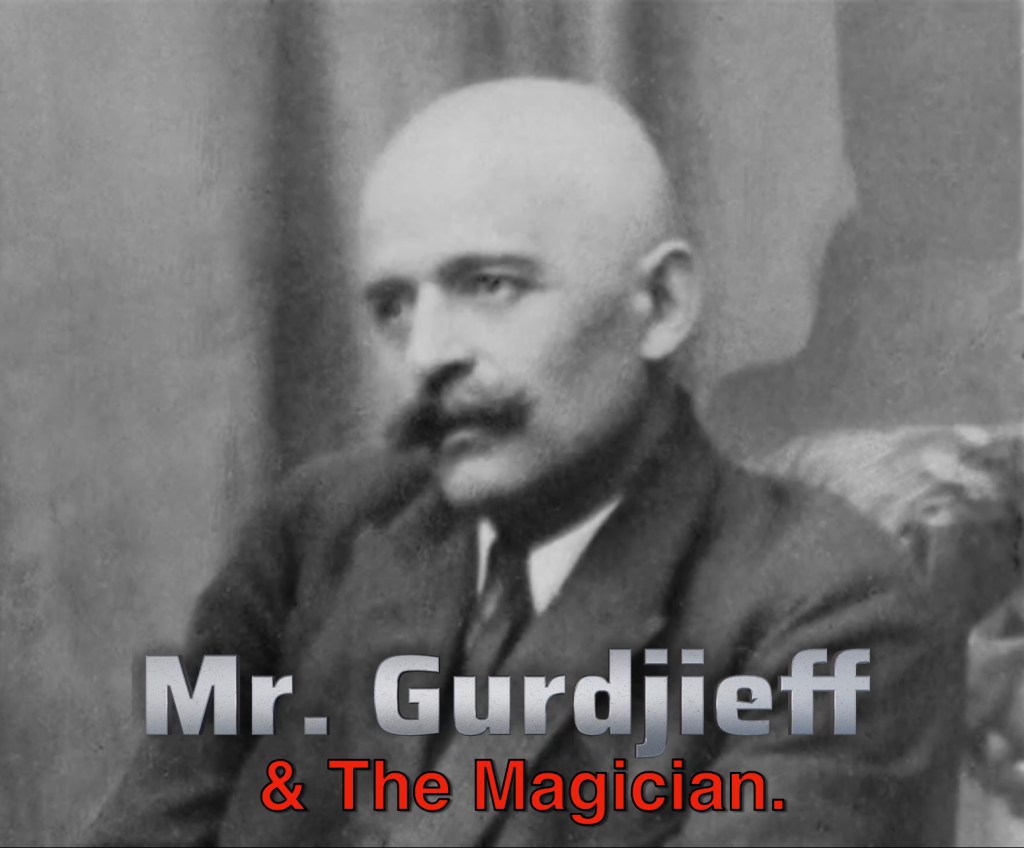
I have followed the ideas of Mr. Gurdjieff for 45 years now. He was a very special person. I have attempted to mix my study of the Fourth Way with my lifelong love of magic. It has been a very challenging G.I. Gurdjieff was born around 1866 (the exact year is debated) in Alexandropol, in the Russian Empire, to a Greek father and Armenian mother—an upbringing rich in cultural and spiritual traditions. His father, a bard and storyteller, exposed him early to epic tales and oral wisdom, which sparked his lifelong fascination with ancient knowledge. Raised in a region at the crossroads of East and West, Gurdjieff was immersed in Christian, Muslim, and esoteric influences from an early age.
As a young man, Gurdjieff pursued a restless quest for truth, traveling through Central Asia, the Middle East, and North Africa, seeking hidden spiritual schools and ancient teachings. These journeys formed the mysterious backbone of his later teachings, which blended Eastern mysticism with Western psychology in a system he called “The Fourth Way.” Rather than withdrawing from the world, Gurdjieff insisted that real inner development must occur within the chaos of everyday life.
He arrived in Moscow around 1912 and began attracting a circle of devoted followers. His charismatic, enigmatic persona and radical ideas shook up conventional spiritual and philosophical circles. Later, fleeing the Russian Revolution, he established the Institute for the Harmonious Development of Man in France, where he continued to teach, write, and develop his system until his death in 1949. Gurdjieff’s influence remains potent today, his legacy passed down through students like P.D. Ouspensky and generations of seekers searching for the ever-elusive “real I.”

The teachings of George Ivanovich Gurdjieff offer a radically different approach to personal development—one that speaks directly to the soul of a performer. Unlike the traditional spiritual paths of the fakir (physical endurance), the monk (devotion), or the yogi (intellect), Gurdjieff’s Fourth Way demands engagement with all aspects of the self simultaneously, and in the middle of ordinary life.
For the magician, this idea isn’t foreign. He must master his body’s mechanics (the sleights), his emotions (performance energy), and his intellect (understanding of timing, structure, and psychology). The stage is his crucible; it is where self-work happens, not apart from the world, but within its spotlight.
The magician who takes up the Fourth Way begins to perform not just for applause but for evolution. The act becomes a meditation, and the audience, unwittingly, becomes part of his spiritual experiment.
Posted by Nick Lewin
Categories: Magic, Magic and Magicians
Tags: GI Gurdjieff, Metaphysics, philosophy
Mobile Site | Full Site
Get a free blog at WordPress.com Theme: WordPress Mobile Edition by Alex King.