
Avoiding Pitfalls: Don’t Get Trapped by Your Act
I want to discuss a topic that affects every magician. It is a certain slippery, nebulous, ever-changing concept called “The Act.” I want to give you a quick rundown on why you need an act, how to put the act together, and a topic seldom discussed: how to avoid being trapped by the act. Hmmm, “Trapped by the Act” sounds like a Graham Green novel from the ’50s!

When I first became a magician, I had no idea what an “act” was or how to formulate one. For me, a show was all about the tricks and my exciting new props, and for many magicians it still is. I remember when I joined my first magic club, The Sussex Magic Circle, at the age of 13. I worked from a large table onto which was placed nearly every prop I owned. I wanted to select the tricks in my show “on the fly,” I told myself. Looking back, I realize I just wanted the members of the magic club to swoon over all my exciting boxes, gizmos, and gadgets! One thing that I didn’t have was an act.
During the following years, until I moved to the United States in 1974, I performed every different kind of gig I could book. Kids Shows, Cabaret, Talent Contests, Nightclubs, Cruise Ships, and Corporate Events. You name it – I did it. This gave me a wonderful feel for the material I was working on. It helped me find the strengths and weaknesses of each piece when performing for very different audiences. This allowed me to build an ever-changing list of Openers and Closers. Thse are the first vital blocks used in creating an act. There are many ideas about what works best in these two slots. The simple answer is whatever works best for you but learn the rules of stagecraft before you replace them.

Upon arriving in California in January ’74, it did not take me long to start performing at the Magic Castle in Hollywood, and this was where I began creating the true nucleus of my “act” by performing 28 shows in a week. Then I started to add Middles to my list of Openers and Closers. My dear friend and mentor, Billy McComb, encouraged me to write my routines down on index cards. At the top of each card was the name of the trick, underneath it the kind of trick (i.e. Opener, Closer, Middle, etc.), the approximate running time, the type of trick (i.e. Cards, Mentalism, Silks, etc.) plus every other pertinent detail. Do you need an assistant onstage? What table do you need, if any? On the back of the index card, list every prop you need to perform the effect (deck of cards, black Sharpie pen, silk handkerchief, etc.) All these index cards are then wrapped with a couple of rubber bands, ready to be spread, rearranged, and studied like a deck of ancient tarot cards.
I went into quite a lot of detail about the “Index Card” act building system, and yes, I am aware that every younger magician will say, “I can do that on my computer.” Yes, of course, you can, and if you so desire, I highly recommend the “Drafts 4” App because of the ease with which elements can be adjusted and amended. However, there is something wonderfully physical and delightfully tactile about shuffling those index cards around. I swear it will make you more creative!
By now my show had some strong sequences that were beginning to slot together nicely. I then worked very hard at connecting the magic by integrating some strong linkage in the form of short magical surprises and hunks of comedy. I put all of these “bits” of linkage onto index cards and added them to my collection. Linkage is a very important issue for any magician. The difference between a pro and an amateur magician is that you never notice when a pro is moving from one to the next – unless he wants you to. With less stage time, the tendency is to perform a trick, and when you finish it, start another.
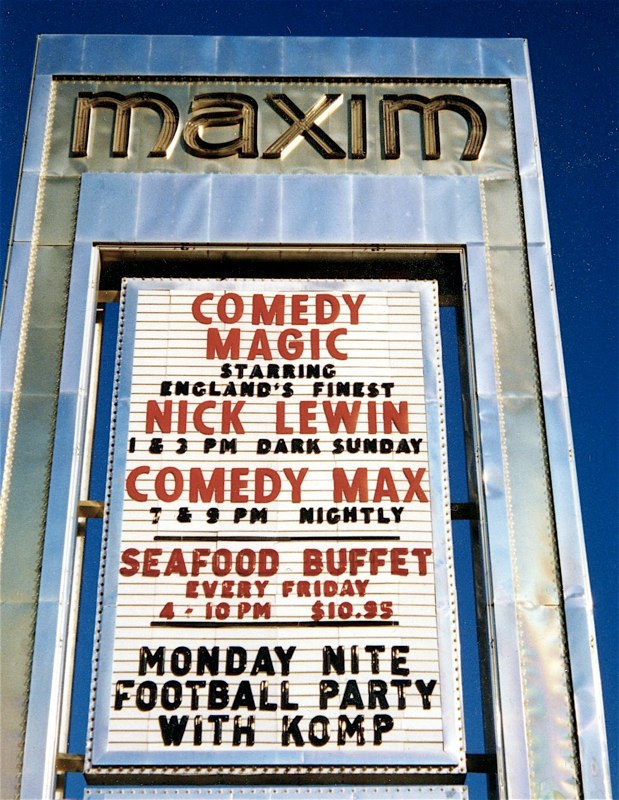
Starting in the 1980’s, I spent 11 years headlining on the comedy club circuit. This was the time that I polished and perfected my show. I learned a great deal from my time spent in the comedy world. Young comics worked hard every day creating new and topical jokes and I picked up tips galore. I learned how to structure a good callback and to use fewer words to tell a joke. I fine-tuned the act until it became a well-oiled machine!
In the mid-’90s, I began a five-year run with my one-man show in Las Vegas. I fervently maintain that the best way to improve your show is to perform it. I had been playing Las Vegas since the late ‘70s, but a long-term show was another thing entirely. Two 65-minute shows a day, six days a week, 48 weeks a year is a lot of shows! By the time I left my Vegas gig, the act was as solid as a rock and smooth as silk. However, it had become so intricately layered, timed, and full of visual and verbal callbacks that the act had become an entity of its own. I was just the curator.

The timing and structure of my act were taking away the spontaneity from my work. I tried some fun ways to explore this new situation; my favorite stunt was reversing the running order of my show. Yes, if you want to acquire some serious insight into your act, give this technique a shot. What did I learn from this “Act Reversal Exercise?” Having spent decades getting the act exactly where I wanted it, I discovered that playing with the line-up structure of the show left me free to scatter my stand-up comedy into new settings.
It was very liberating when I recently decided to retire my “old” act. I had made a great living and lots of money with those tricks, gags, and bits that had eventually evolved into my “Act.” However, I am currently working on a new show that uses nothing from the old act. What is life without a challenge? My Bottom Line: A performer must create an act that will work anywhere, anytime, for anyone. Then, they must learn to perform it anywhere, anytime, for anyone. Once you have got your act together, make sure you don’t get trapped by it!

 REMARKABLE MAGIC